

Vitamin K2 is one of those nutrients that wasn’t getting much attention, yet it has always quietly supported the body in numerous, essential ways. While many people have heard of vitamin K1—best known for its role in blood clotting—K2 does things quite differently. It is now becoming more widely known that K2 supports the utilisation of calcium in the body, supporting bones to be strong and blood vessels to be flexible. This “calcium-guiding” support is one of the clearest roles of K2, but it does have other benefits. It supports almost all major body systems and directly or indirectly participates in the support of hundreds of physiological processes—ready to learn about the vital fat-soluble vitamin K2 and learn some practical tips for you and your family? Here we go….

Firstly, what is a “fat-soluble” vitamin?
A fat-soluble vitamin (FSV) is one of the four essential vitamins (A, D, E, and K) that dissolves in fat, is absorbed with dietary fat, and gets stored in the body’s fatty tissues and liver, unlike water-soluble vitamins (C and the Bs) that are (mostly) flushed out if unused.
Throughout the twentieth century, we viewed the FSVs in isolation from one another and virtually ignored K2. But they actually cooperate synergistically not only with each other, but also with essential minerals like magnesium and zinc, with dietary fat, and with key metabolic factors like carbon dioxide and thyroid hormone. They also help to support each other from becoming toxic.
Synergistic examples:
- Vitamins A, D, and K2 interact synergistically to support immune and reproductive health, adequate growth, and strong bones and teeth.
- Vitamins A and D support the absorption of zinc and zinc supports the absorption of all the FSVs.
- Vitamin K2 supports proteins by adding carbon dioxide to them. We can support carbon dioxide production by consuming carbohydrates, exercising, and maintaining robust thyroid status.
What is vitamin K?
Vitamin K is a family of fat‐soluble molecules consisting of three subtypes, K1 (phylloquinone), K2 (menaquinones), and K3 (menadione). They each contain a common core structure of a methylated naphthoquinone. K1 is found in green leafy plants and algae (via photosynthesis) and K2 is found in animal and some fermented foods (predominantly via certain bacterial synthesis). K3 a synthetic form of vitamin K used primarily in animal food (poultry, pets); however, it’s not used in human supplements due to toxicity risks.
Vitamin K2 exists as several menaquinones (MK-n), ranging from MK-4 to MK-13. The most significant forms for human health and supplementation are MK-4 (short-chain, found in animal products) and MK-7 (long-chain, derived from fermented foods like natto). MK-4 is the most abundant form in human body tissues and looked upon as the “active” form of vitamin K2. We can make MK-4 from other forms of K2 and can “inefficiently” convert K1 into MK-4. MK-7 has a longer half-life in the blood, therefore better bioavailability in terms of supplementation than MK-4, but these and other forms are required in a healthy diet, based on traditional consumption of foods rich in all forms of vitamin K.
It has been commonly believed that the benefits of vitamin K, in all its forms, are limited to its role in blood clotting. Another belief is that vitamins K1 and K2 are simply different forms of the same vitamin—with the same physiological functions. The K2 vitamin has so many functions not associated with K1 that many researchers insist that K1 and K2 are best seen as two different vitamins entirely.
How Vitamin K2 Works—in Simple Terms
Vitamin K2 supports a group of special proteins whose job is to guide calcium. Think of K2 as the “on switch” that supports these proteins to guide calcium correctly. Without enough K2, calcium may not get fully incorporated into bones and teeth or may end up settling in soft tissues where it doesn’t belong.
Two of the big ones include:
- A bone-building protein that supports calcium to go into the bones where it supports structure. Over time, this can support strong bones and may play a role in supporting joint comfort by supporting the tissues around the joints.
- A vessel-protective protein that supports calcium from depositing in artery walls, supporting flexible, healthy blood vessels.
But, as mentioned, vitamin K2 has many other roles, including:
Energy Production and Mitochondrial Support
Vitamin K2, particularly the MK-4 form, acts similarly to Coenzyme Q10 in supporting the mitochondrial electron transport chain. It can also support healthy ageing.
Immune Response Support
Vitamin K2 has been shown to support a healthy immune response. It also supports the balance of lipids and immune cells.
Brain Health and Nerve Function Support
In the brain, Vitamin K2 (primarily MK-4) supports crucial processes. K2 supports essential lipids for supporting brain cell membranes and signalling. It also supports neuronal health and a healthy myelin sheath.
Reproduction Support
Vitamin K2 supports steroid (reproductive) hormone production.
Gene Expression and Cellular Growth Support
Vitamin K2 supports gene health in specific tissues, supporting many functions and processes in the body as a result. It has also been shown to support liver detoxification and health.
Many areas are still being explored, but an overall picture is emerging of a nutrient that supports the body’s overall “maintenance systems.”
K2 for Kids and Teens: Building the Foundations of Lifelong Health
Children and adolescents may actually need proportionally more K2 than adults because their bones and tissues are growing so rapidly. This essential vitamin is required in childhood to support, among other things, cardiovascular health, hormones, bones and teeth, stature/height, posture and skull shape, mouth health, and ease of breathing as they mature. Thie is most probably why traditional humans made sure they gave plenty of foods rich in vitamin K2 (and the other FSVs) to their growing children.

Where We Get K2: Diet + the Microbiome
Dietary sources
Vitamin K2 is found mainly in:
- fermented foods, like kefir, yoghurt, and especially natto, a traditional Japanese soybean dish)
- Pasture-raised Goose and other animal livers (have with butter to absorb the K2)
- fermented dairy products, butter, and certain aged and hard cheeses
- egg yolk, dark poultry meat, and other organ meats
- Animal fat, to varying degrees
Levels vary widely depending on how foods are raised or fermented. Fermented foods tend to be consistently rich sources but look for natto or fermented full fat dairy for the best sources within the ferments. There is K2 in sauerkraut and kimchi, etc., but in much smaller volumes. Do consume these foods, as they are wonderfully healthy.
Your gut bacteria can make some K2 too
Certain gut microbes naturally produce forms of vitamin K2. This means that a healthy microbiome may contribute to your overall K2 supply. However, how much of this gut-produced K2 the body actually absorbs is still being studied.
What We Still Don’t Know...For Sure
While the research on K2 is promising, there are still gaps:
- There is no recommended daily intake, but there is an Adequate Intake (AI) indicated, which some experts say is at least 1 mcg of K2 per kilogram of body weight for adults. That is only estimated to support bone-related proteins. Many experts recommend at least 90 mcg up to 300 mcg daily for adults. Research shows up to around 45 mg a day as being useful to support age-related bone health, at least in the shorter term and for those already experiencing issues with their bones or cardiovascular system health. See below for Adequate Intakes of Vitamin K2 by age*
- Long-term outcomes—especially in children—need more large studies. But we can look to traditional intakes of all the FSVs, not just K2, which are a lot higher than in modern, western diets.
- Epidemiology suggests that the cultures that consume more K2-rich foods like cheeses, animal fats, and natto appear to be far more supported when it comes to heart and bone diseases. This needs to be confirmed by experimental data.
- Gut-produced K2 is promising but not fully understood. Evidence points it to being more an evolutionary hang over, from when we relied more on hind-gut fermentation.
Still, the weight of evidence suggests that getting enough K2 is an important part of supporting lifelong bone, heart, reproductive, genetic, and developmental health.
Practical Tips for Families
- Offer a range of foods that naturally contain K2 (cheese, eggs, dark poultry meats, liver, fermented foods, etc.).
- Make fermented foods a fun staple—try yoghurt, kefir, sauerkraut, or new cheeses.
- Think of K2 as part of the “bone team” alongside calcium and other minerals, vitamin D, protein/collagen, and weight-bearing movement.
- Support your microbiome with a bit of fibre everyday (not too much…) in a non-processed food diet and note that antibiotics can disrupt K2-producing bacteria.
- If a child has restricted diets, gut issues, or slow growth, talk to a clinician about checking vitamin K2 status.
- Supplementation has been shown to be suitable even at high doses. Try a quality Vitamin K2 product if you need to supplement your diet.
*Adequate Intakes by age:
- Infants (0-6 months): 2.0 mcg
- Infants (7-12 months): 2.5 mcg
- Children (1-3 years): 30 mcg
- Children (4-8 years): 55 mcg
- Children (9-13 years): 60 mcg
- Adolescents (14-18 years): 75 mcg for boys and 60 mcg for girls
- Adults: at least 90 mcg per day, with some experts saying up to 300 mcg or more
These recommendations are based on guidelines from the US National Institutes of Health (NIH).
Introducing Good Health Vitamin K2 Melts
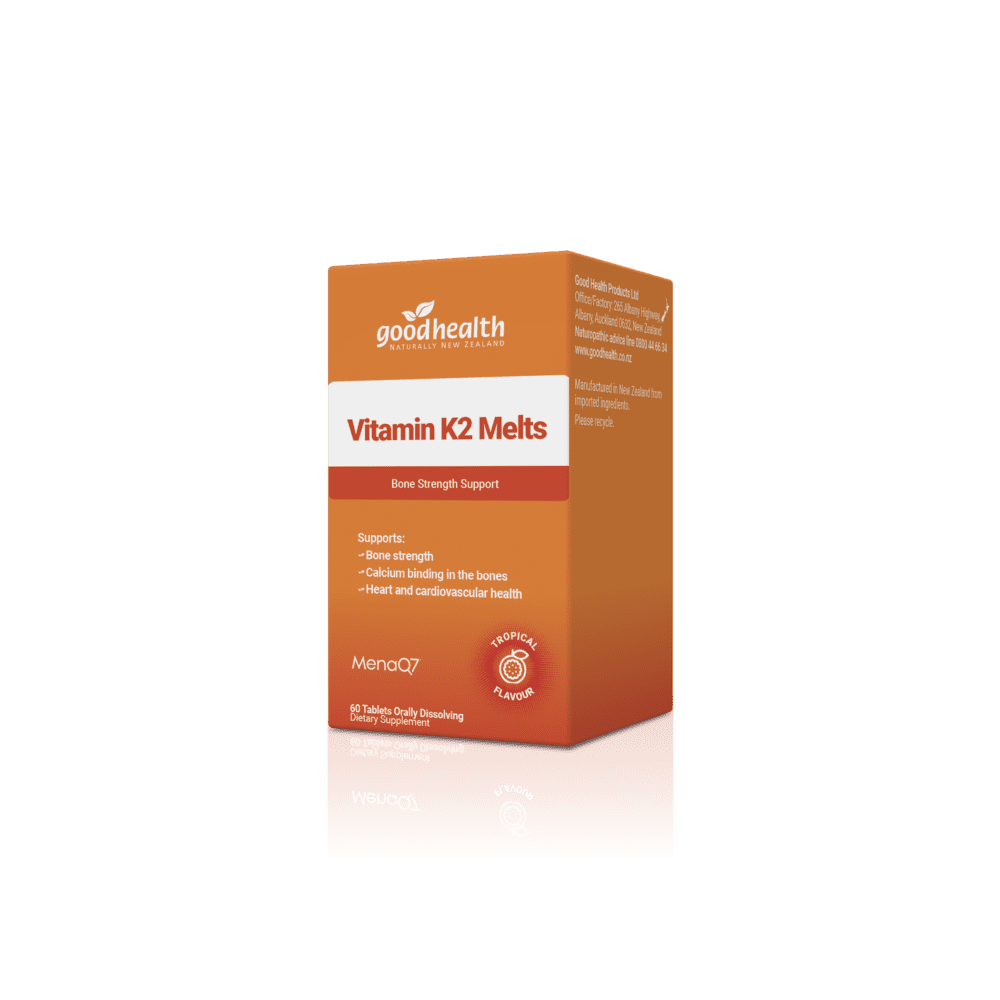
Good Health Vitamin K2 Melts is a scientifically developed formulation that contains MenaQ7, a form of Vitamin K2 that supports production of osteocalcin, supporting bones and teeth to stay healthy and strong, especially as we age. Vitamin K2 Melts also supports blood sugar balance, reproductive hormone health, and cellular growth, energy, and maintenance. Vitamin K2 Melts may have an additional health benefit of supporting the inhibition of calcium build up in the arteries, as well as cardiovascular and heart health as we age. Vitamin K2 Melts have a pleasant-tasting, tropical flavour, and you can take them anytime, every day.
For Added Bone Support Try Good Health K2 & D3
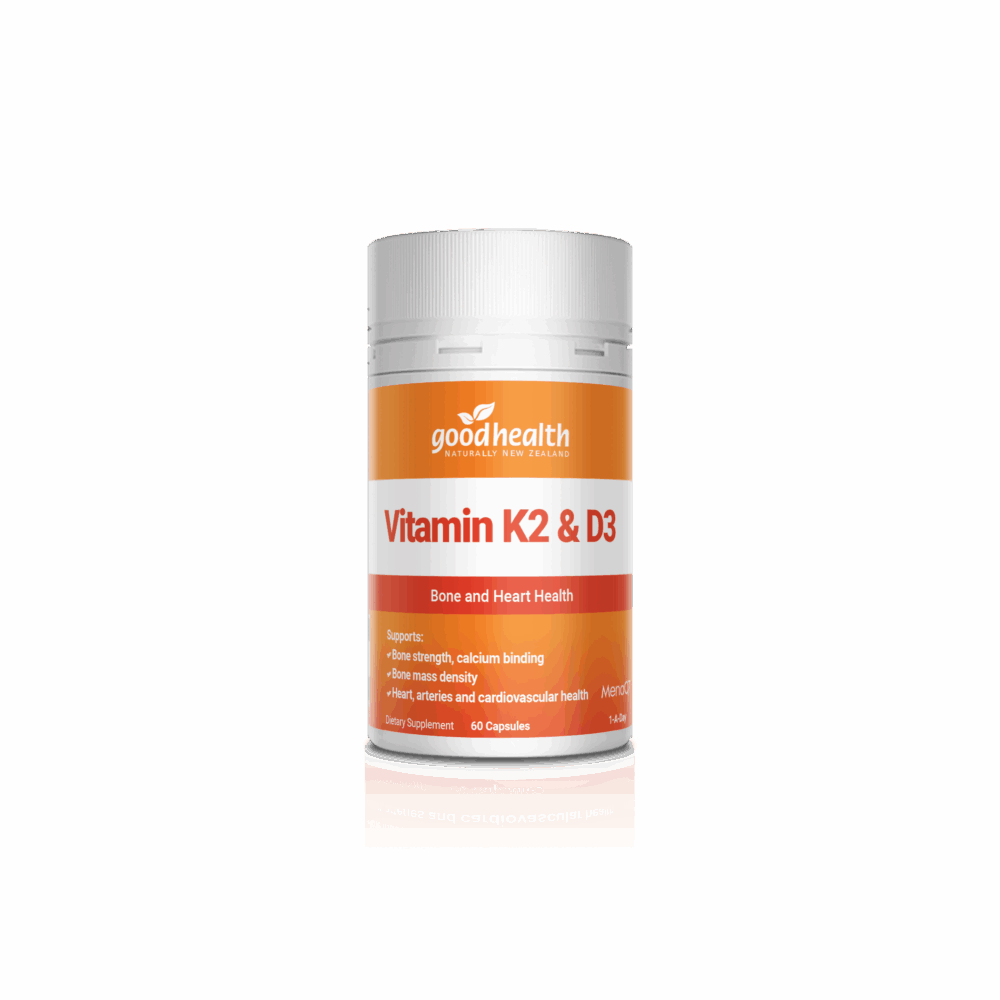
Vitamin K2 and D3 are a powerhouse duo for supporting bone, heart, and whole-body health. Vitamin D3 supports your body to absorb calcium, while K2 supports that calcium to go where it’s needed—your bones and teeth—instead of letting it build up in arteries or soft tissues. Together, they support strong bones, flexible arteries, and immune function. This dynamic pair also plays a key role in supporting metabolic balance, reproductive wellness, and healthy gene expression. When combined, K2 and D3 create the perfect synergy, supporting you to feel resilient and vibrant from the inside out—every single day.
The Bottom Line
Vitamin K2 may be one of the most underrated nutrients. From guiding calcium to support strong bones and teeth, to supporting flexible blood vessels, and children to develop healthy skeletons, K2 plays roles that affect us at every age. By eating a varied diet with animal and fermented foods, supporting a healthy microbiome, and making sure both adults and children get the nutrients needed for strong bones and tissues, we can naturally support K2 levels and the many systems that depend on it.
TAPS PP5358


 English
  Chinese
  Vietnamese